No impeller, no gear train, no magnetic coupling. Two transducers exchange a signal across the water column, and the time difference is the flow.
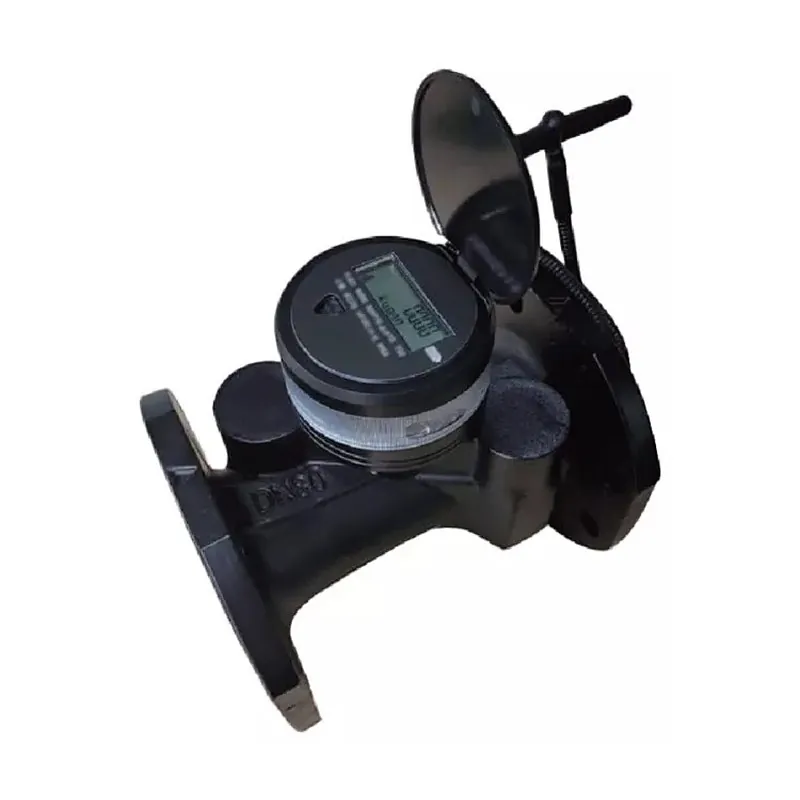
A transducer sends an ultrasonic pulse downstream and another sends one upstream. Water moving with the signal shortens the downstream transit; water moving against it lengthens the upstream one. The difference in transit time is proportional to the average velocity in the measuring section, and velocity × area gives flow.
Because the measurement is time-based and happens through the pipe wall or a sealed port, there is nothing in the water path to wear, jam or be influenced by a magnet. That is the whole reason the reading holds over years of service.
What that means at the point of installation — orientation ranking, air in the run, and why signal quality is drawn from the same battery as the reading — is covered in our installation guide.

Qualitative comparison of the three technologies you will be offered for the same duty. The right choice depends on water quality, turndown requirement and budget — not on which one is “newer”.
| Criterion | Mechanical multi-jet | Ultrasonic (transit time) | Electromagnetic |
|---|---|---|---|
| Moving parts | Impeller and gear train | None in the water path | None, but needs a liner and electrodes |
| Low-flow response | Falls away below starting flow | Good — high turndown available | Limited at very low velocity |
| Water quality | Sensitive to grit and scale | Sensitive to heavy air / solids in the beam path | Needs conductive water; electrodes foul |
| Pressure loss | Noticeable at high flow | Very low — straight bore | None — full bore |
| Magnet tampering | A known attack route | Not applicable | Not applicable |
| Battery operation | Not applicable | Yes, multi-year on lithium | Usually mains powered |
| Best fit | Cost-driven domestic metering | Revenue metering, DMA, IoT retrofit | Large industrial and dirty conductive water |
The electromagnetic column has two hard limits that decide whether it is even an option — water conductivity below 5 µS/cm, and the grounding case at the flange. Both, plus the range ratio you choose rather than inherit, are set out in the electromagnetic meter guide.
The same meter body can leave the factory with any of these interfaces. The decision is about who owns the network and how often you need a reading.
Choose when you own or share a gateway network and want no operator dependency. Good for dense districts where you control the concentrators.
Trade-off: you own the network build.
Choose when you have no gateway and want the meter to work out of the box on a licensed network. Low data volume suits infrequent reporting.
Trade-off: depends on operator coverage in the pit.
Choose when you need higher bandwidth or more frequent reads, or the site already has Cat.1 coverage.
Trade-off: higher power draw shortens battery life.
Choose when you need a self-forming mesh across many nodes with no operator involvement.
Trade-off: mesh planning and node density matter.
Choose when a PLC, SCADA or local controller is already in the chamber or the plant.
Trade-off: needs a cable run and local power for the bus.
Choose when a building already runs an M-Bus backbone for heat or water meters.
Trade-off: wired topology, usually indoors or in a riser.
How the module sits inside the housing, and what the body material does to the reading over time, is covered in our guide to smart water meter materials and structure.

It depends on what “dirty” means. Suspended solids that scatter the beam, or free air after a pump, degrade any ultrasonic measurement. Sand and scale that would stall an impeller are usually far less of a problem for ultrasonic. Send a water sample description and we will tell you honestly whether ultrasonic is the right choice — for some duties electromagnetic is better.
Rated life is quoted at a defined reporting interval — 10+ years on the XY series, 8+ on the bulk meter, 6+ on the LXSY, each under its own stated duty. Halve the interval and life shortens roughly in proportion. We confirm the figure against your actual reporting profile before shipment.
Class 2 is the normal requirement for revenue metering under ISO 4064. If your national regulation specifies a different class or ratio, tell us at inquiry stage — the platform supports several ratio options from R100 to R400.
Yes, and we recommend it. We quote a bench unit for that, and the protocol document lets your integration team validate the telegram, register map and alarm set. Detail changes found at that stage are cheap; found after mass production they are not.
Sealed housing, gland-sealed cable entry and a fitted tamper seal that shows if the cover has been opened. Reverse-flow and empty-pipe events are logged as alarms, so a bypass attempt leaves a record rather than a lower reading.
Yes. AMR / AMI data monitoring and control is one of our four business segments, alongside meters, IoT communication equipment and AI-based consumption analysis. We can supply meters only, or meters plus the reading network.
Calibration records tied to serial numbers, declaration of conformity, and test reports from our CNAS-accredited laboratory where applicable. For OEM projects the document set is agreed in the contract.
Which size actually measures the flow you have, and who owns the network the readings travel over. Both have their own guide.
Oversizing costs money and loses low-flow accuracy; undersizing wears the meter out. How to pick the size from your real flow range.
Read the sizing guide →Who owns the network, who pays the SIM, what the battery budget allows — and which uplink survives a concrete pit.
Read the uplink guide →When the tender asks for paperwork: what each water-meter document actually proves — ISO 4064 reports, OIML R49, CNAS accreditation and CE.
Meter already in the ground and reading wrong? The failure-mode guide starts from the symptom and works back to the cause.
Describe the water, the pipe and the reading you need. If ultrasonic is wrong for the duty, we will say so and propose what else works.
Interface translated. Technical documents stay in English.
