Compact DN15–DN80 for buildings and bulk DN50–DN300 for distribution lines — two sensing technologies, five meter families, one purpose: a reading that stays accurate when the water is dirty, the pit is flooded and the pipe run is short.
Four-channel flanged meter for distribution mains and plant rooms. Class 2, R400 / R250, 1.6 MPa body, IP68, 3.6 V battery, 4G / LoRaWAN / RS485 remote reading.
1/2" transit-time ultrasonic meter with a valveless threaded body. Class 2, R1000 available, IP68, PN10 (2.5 MPa on request), −25 to +55 °C, 9-digit LCD, RS-485 / M-BUS plus one optional LoRaWAN, NB-IoT, 4G Cat.1 or Wi-SUN module.
Transit-time ultrasonic measuring tube with an integrated gear-motor ball valve. Class 2 accuracy, R100–R400, 10+ year battery and LoRaWAN / NB-IoT uplink for prepaid, leakage and shut-off control.
Non-magnetic registration that cannot be influenced by an external magnet, in an IP68 housing rated for damp, buried and flooded sites. Six-year battery with daily reporting over 4G Cat.1, NB-IoT, LoRaWAN or Wi-SUN.
Transit-time measurement from DN15 to DN50 with no moving parts: Class 2 accuracy, IP68, R200 / R400, and one pre-installed module for RS485, M-BUS, 4G, NB-IoT or LoRaWAN.
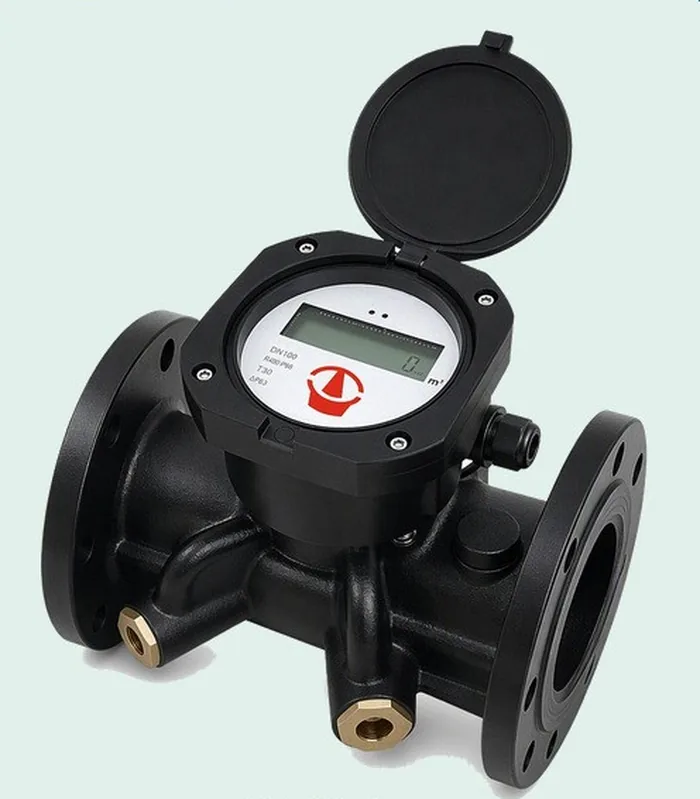
Large-diameter flanged meter for district mains and plant rooms. Q3 40 m³/h, Class 2 to ISO 4064, R400, 1.6 MPa carbon steel body, IP68, LoRaWAN / NB-IoT / 4G / RS485.
One-piece cast metal body with machined flanges, a straight-through bore and brass-capped transducer ports. Valve-free, low-power, NB-IoT uplink with Modbus for PLC and SCADA at the panel.
The range looks wider than it is. Seven of the eight models are transit-time ultrasonic; the eighth, the LXSY, is a non-magnetic mechanical meter kept in the range for tenders where tamper resistance or unit price decides the line. Between them, four things change — and each one is decided by the site rather than by preference.
Sensing principle. The ultrasonic families measure the water directly. The LXSY is the exception in the range: it is a non-magnetic mechanical meter, chosen where a magnetic tamper risk or a very low unit price decides the tender. It is on this page because it is sold into the same projects, not because it measures the same way.
A valve or no valve. The XY-15 adds a motorised valve so the utility can shut a connection remotely or run prepaid credit. That valve is the reason its duty cycle is harsher than any other meter here: a household that closes and opens daily is the hardest thing in this catalogue to power.
Size and how it mounts. DN15 to DN25 are threaded service connections; DN50 and above are flanged. Between them sits the LXCY-15~50, which covers the sizes where a utility is still on a threaded connection but the flow has outgrown a domestic meter. Above DN50, the LXCY-50~300 takes the district and bulk duties.
The way the reading leaves the pit. The same measuring tube is offered with LoRaWAN, NB-IoT, RS-485 / Modbus or M-Bus. This is the variable buyers most often fix too early: it decides who owns the network and who pays for the SIM, which is a commercial question before it is a technical one.
The one thing that does not change is the metrology. Q3, Q4 and the Q3/Q1 ratio mean the same thing in every family, which is why the table below can put them side by side without a caveat.
Reading the table
What the columns actually decide
Four columns carry almost all of the consequence in a tender. The rest of the sheet is installation detail.
Q3 and Q4. Q3 is the permanent flow the meter is rated for; Q4 is the short-term overload it must survive. Size to Q3 against your real peak, not against the pipe bore — a meter sized to the pipe runs near the bottom of its range for most of the day.
The ratio, R. R is Q3 divided by Q1, the smallest flow the meter still counts within tolerance. A higher ratio is what lets one meter serve a household with a dripping tap and a garden tap on the same day. It is also the number that costs money, so it is the one to justify against the tariff rather than the datasheet.
Accuracy class and temperature class. Class 2 is the normal revenue requirement. The temperature class is a hard limit, and the one specification buyers most often discover they needed after the line has run hot for a summer.
Enclosure and battery. The enclosure rating decides whether the pit can flood. The battery figure is only meaningful together with the reporting interval — a ten-year life at one read a day is a different product from a ten-year life at one an hour.
Choose by pipe size first, then by how the reading leaves the site. Every family is available with OEM branding and a market-specific protocol.
DN15 LoRaWAN
XY-15 / XY-20
LXSY-15 / 20 / 25
LXCY-32~50
DN80 in-line
Nominal size
DN15 (1/2")
DN15 / DN20 / DN25
DN15 / DN20 / DN25
DN32 / DN40 / DN50
DN80 (3")
Sensing
Transit-time ultrasonic
Transit-time ultrasonic
Non-magnetic register
4-channel transit-time
Transit-time ultrasonic
Accuracy class
Class 2
Class 2
Class 2
Class 2
Class 2
Flow ratio
R400 – R1000
R100 – R400
R160 – R400
R400
R250 – R400
Q3 range
On request
2.5 / 4.0 / 6.3 m³/h
2.5 / 4.0 / 6.3 m³/h
16 / 25 / 40 m³/h
100 m³/h
Body
Threaded metal body
Stainless steel / brass
Brass / stainless steel
Metal, flanged
Cast metal, black coated, flanged
Valve
None — valveless
Integrated ball valve + gear motor
Optional valve control
Optional
None — valve-free bore
Wireless uplink
LoRaWAN / NB-IoT / 4G Cat.1 / Wi-SUN
LoRaWAN / NB-IoT / 4G Cat.1 / Wi-SUN
4G Cat.1 / NB-IoT / LoRaWAN / Wi-SUN
LoRaWAN / NB-IoT
NB-IoT
Wired
RS-485 / M-BUS
RS485 / M-Bus
RS485 / pulse
RS-485
Modbus
Battery
Per configuration
10+ years, 3.6 V Li-SOCl₂
≥6 years, 3.6 V lithium
≥8 years, 3.6 V lithium
Low-power design
Protection
IP68
IP68
IP68
IP68
Sealed housing, gland entry
Typical use
1/2" service line, single dwelling
Household revenue, prepaid, leak control
Household revenue where magnets are a risk
District & building boundaries
Plant lines, buried chambers
Values shown are the standard configurations. Flow parameters, pressure rating, temperature class and protocol can be customised — tell us the site conditions and we confirm the exact model.
Choose by uplink
Same meter, different way out of the ground
Most of the range can be ordered with either module. Which one belongs on your site depends on one question: do you own a gateway?
Two long reads for the questions that come after the datasheet: what the meter is actually built from, and how to work out a flow range when the pipe is not a water main.
Start with the pipe size, then with how the reading leaves the site. The table above lists the families side by side on both counts. If you are still between two sizes, put your peak flow and the smallest flow you need to detect into the sizing calculator and it returns the bore and the range ratio that covers it.
Which families can be ordered with LoRaWAN or NB-IoT?
The DN15, XY-15/20 and LXSY families take LoRaWAN, NB-IoT, 4G Cat.1 or Wi-SUN. LXCY-32~50 takes LoRaWAN or NB-IoT. The DN80 in-line meter is NB-IoT only, with Modbus as its wired path.
Is the accuracy class the same across the range?
Yes, Class 2 on every family. The flow ratio is what varies: R400–R1000 on the DN15, R100–R400 on XY-15/20, R160–R400 on LXSY, R400 on LXCY-32~50 and R250–R400 on the DN80.
Can the meter carry our own brand?
Yes. Every family is available with OEM branding and a market-specific protocol, so the unit does not have to arrive carrying our name. Tell us the market and we confirm which configuration applies.
What can be customised?
Flow parameters, pressure rating, temperature class and protocol. The values in the table are the standard configurations — send us the site conditions and we confirm the exact model rather than quote a catalogue entry that does not quite fit.
Not sure which meter fits
Send us the pipe size and the protocol you run
We will come back with one recommended model, the wiring diagram and a quotation — not a 40-page catalogue.