Not sure this is the right bore? Work it out from your peak and minimum flow — the sizing calculator needs two numbers.


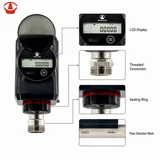

A 1/2-inch transit-time ultrasonic meter with nothing in the water path to wear: no impeller, no gear train, no valve. It reads in both directions, holds Class 2 accuracy down to the low-flow band, and sends the reading out over LoRaWAN — or NB-IoT, 4G Cat.1 or Wi-SUN, whichever network you already run.
The platform covers DN15, DN20 and DN25 on the same body design. Flow parameters and the wireless module are fixed per order — tell us the network and the flow range you must cover and we confirm the exact configuration.
| Configuration | Ultrasonic water meter, DN15 (1/2") — LoRaWAN |
|---|---|
| Nominal diameter | DN15 (1/2") · series also covers DN20 (3/4") and DN25 (1") |
| Measurement principle | Transit-time ultrasonic |
| Flow direction | Bidirectional |
| Accuracy class | Class 2 |
| R-ratio options | R1000 / R800 / R630 / R500 / R400 |
| Display | 9-digit LCD with menu button |
| Protection grade | IP68 — fully submersible |
| Working pressure | 1.0 MPa (PN10) standard · 2.5 MPa optional, quoted separately |
| Operating temperature | −25 to +55 °C |
| Battery | 3.6 V lithium, ≥10 years, maintenance-free |
| Wired communication | RS-485 / M-BUS |
| Optional wireless module | 4G Cat.1 / NB-IoT / LoRaWAN / Wi-SUN — one module per meter |
| Local configuration | Bluetooth / IR |
| Connection | Threaded, both ends; sealing ring at the joint |
| Body | Valveless straight-through measuring tube, cast flow-direction mark |
| Installation | Horizontal or vertical, flow direction marked on the body |
The wireless module is chosen when the order is placed and pre-installed at the factory — one module per meter, so the unit arrives ready to join your network rather than needing a site fit.
Long-range, low-power uplink for utilities that own or share a gateway network — no operator dependency for the data path.
Real-time and historical readings arrive at the head-end, so a billing cycle no longer depends on someone walking the route.
Usage patterns and network health across the whole deployment, not one meter at a time.
Consumption analysis feeds leak detection, demand forecasting and non-revenue-water programmes.
Measures flow without moving parts — grit and scale cannot slow the reading down.
Built with data security in mind to protect the network and the meter data on it.
RS-485 / M-BUS and standard wireless modules fit an existing smart water infrastructure.
The same platform scales from a pilot of a few hundred units to a city-wide rollout.
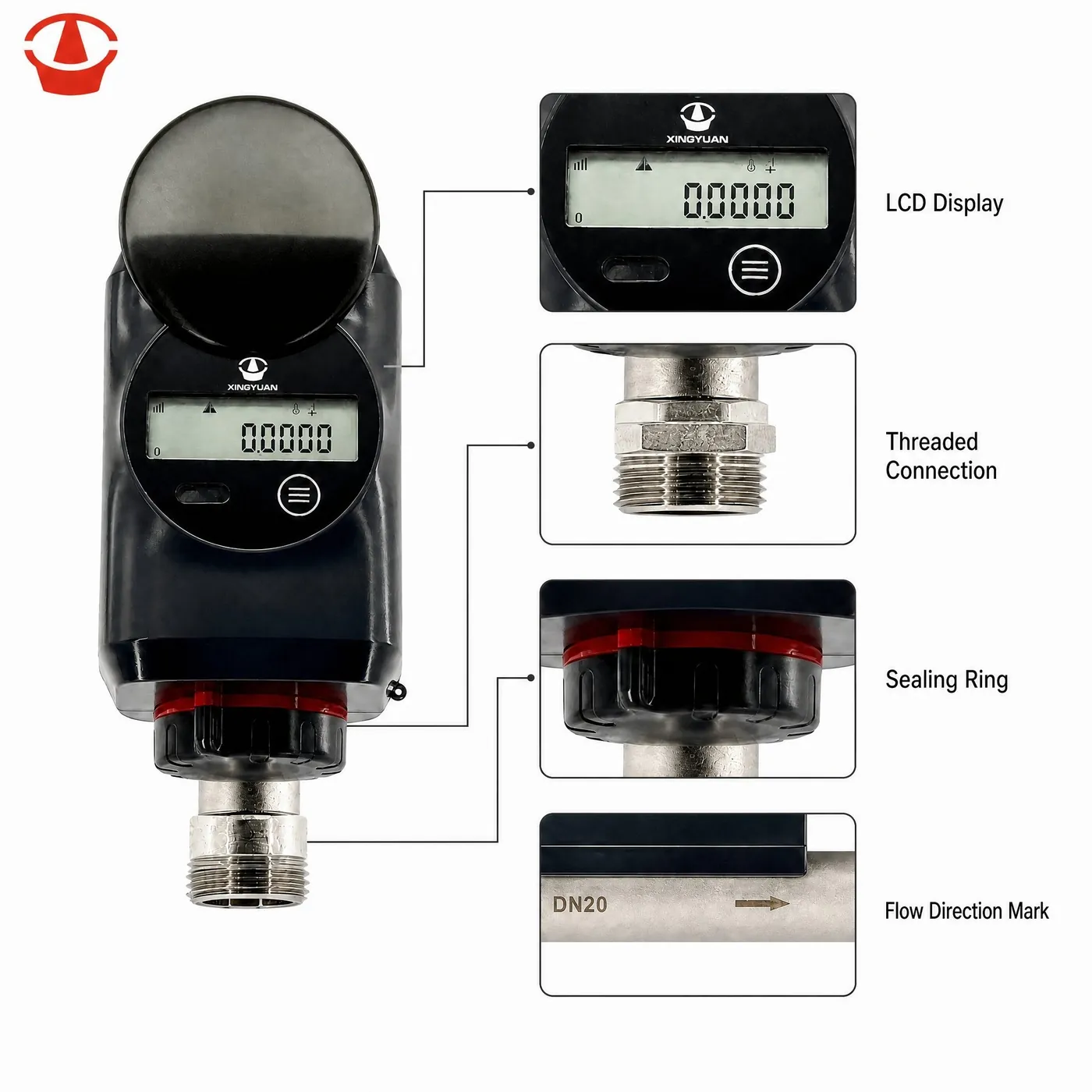
These are the parts that decide whether a meter survives ten years in a cabinet — and every one of them is visible without opening the unit.

Two transducers exchange a signal across the water column. Moving water shortens one transit and lengthens the other; the difference is the velocity, and velocity × area is the flow. Nothing in the bore is being pushed by the water, so nothing wears.
Only one wireless module is fitted per meter. Wired RS-485 / M-BUS is available alongside it.
The body is valveless: the bore runs straight through, inlet to outlet, with the flow arrow cast on the side. That removes a wear item, keeps pressure loss low, and lets the meter sit horizontally or vertically in a tight riser.
Orientation is a ranking rather than a free choice, and a weak signal is paid for out of the battery — both are explained in our installation guide.
The pressure rating is the item buyers most often misread on this page: PN10 means 1.0 MPa and is what ships as standard. A 2.5 MPa rating is a different body and is quoted separately. Everything below follows the same rule — left column is in every unit, right column is fixed when the order is placed.
Nothing in the right column is fitted unless it is written on the order. If a tender asks for something outside both lists, send the clause and we answer against it rather than against a general datasheet.
The same meter is built on DN15, DN20 and DN25 bodies. Flow parameters are confirmed per model at order — send the design flow and the minimum flow you need to detect.
| Nominal diameter | Thread | Typical point of use | R-ratio |
|---|---|---|---|
| DN15 (1/2") | 1/2" threaded | Single apartment, small dwelling | R1000 / R800 / R630 / R500 / R400 |
| DN20 (3/4") | 3/4" threaded | Apartment block riser, small commercial unit | R800 / R630 / R500 / R400 |
| DN25 (1") | 1" threaded | Building inlet, workshop, irrigation branch | R630 / R500 / R400 |
Ratio availability is confirmed per size and per order. Higher ratios are only worth paying for where the minimum flow you must detect is genuinely small.
Choosing between a turbine and an ultrasonic body at these sizes — and what separates a 10,000-unit order from a 25,000-unit tender — is covered in the DN15–DN25 comparison.
The ratio describes how far below nominal flow the meter still measures accurately. R1000 sees a much smaller trickle than R400, which matters where you are hunting leaks at the service connection. If your minimum flow is not that small, R400 is the cheaper choice and equally accurate in band.
The wireless module is pre-installed per selected configuration — one module per meter. Decide the network at order: LoRaWAN, NB-IoT, 4G Cat.1 or Wi-SUN. Wired RS-485 / M-BUS is available alongside it.
Not for metering. This is a valveless configuration — a straight-through bore with no actuator. If you need remote shut-off for prepaid or credit control, take the XY-15 / XY-20 valve control version instead.
Life depends on the wireless module and the reporting interval you set, so we quote it against your configuration rather than publishing one number that would be wrong for most projects. Tell us the reporting interval and we confirm the figure before the order.
Yes — Bluetooth / IR local configuration is supported, so parameters can be checked or changed at the installation point without pulling the meter.
The housing is sealed to IP68, so a cabinet or pit that takes on water does not end the meter's life. The threaded joints and sealing ring are the parts to check at commissioning.
Send the DN mix, the R-ratio you need, the network you will join and the annual volume. You get a model code, the protocol document and pricing in one reply.
Interface translated. Technical documents stay in English.
