DN50 bulk ultrasonic water meter: what the specification sheet leaves out
A two-inch flanged meter for district mains and irrigation blocks. Dual-channel transit-time measurement, R400 span, IP68 down to the cable gland, and one communication module per meter. This is the reasoning behind each line on the datasheet — and the four places where a cheaper meter quietly gives up.
Bulk metering is where a water utility finds out whether it bought a meter or a number — and on a district main or an irrigation riser, a bulk ultrasonic meter is the only type that measures without touching the water. At DN50 the flows are large enough that a two percent error is money, and the installation is usually a chamber or a plant room that nobody visits for months. Everything below is about that reality — not about the diameter.
The DN50 flanged unit. Two-inch bore, bolted flange ends, hinged cover over the LCD register.
Core advantage: two-channel transit-time measurement, no impeller
The meter measures by transit time. Two transducers sit at opposite ends of a diagonal acoustic path and fire alternately — once with the flow, once against it. The difference between the two travel times is proportional to the velocity of the water — the transit-time principle — and the tube cross-section turns velocity into volume. The second channel averages the two readings, which is what keeps a two-channel meter stable when the velocity profile is not perfectly symmetrical.
Sound pulses sent with and against the flow. The travel-time difference is the measurement.
Three consequences follow, and they are the ones that matter over a ten-year horizon:
No rotating impeller
There is nothing in the water path to wear, jam on grit, or foul with scale. A mechanical meter loses accuracy gradually and nobody notices until the bills do not reconcile.
No calibration drift from friction
Bearing wear is the main reason a multi-jet meter drifts low at small flows. Without a bearing, that failure mode does not exist.
Minimal pressure drop
A full-bore path costs almost nothing in head, which matters on a gravity-fed irrigation main or a network already running close to its pressure floor.
R400 dynamic span
The meter still measures at 1/400 of its permanent flow. Night leakage on a district main sits in exactly that band — the place a narrow-range meter stops counting.
The distinction that decides the purchase: a wide range ratio is not a marketing number. It is the difference between seeing a leaking main at 03:00 and discovering it when a customer complains about pressure.
Practical design: LoRaWAN, NB-IoT and local reading
A meter that measures correctly and cannot be read is a meter with a battery and no purpose. The unit carries long-range LoRaWAN telemetry at 915 MHz as the standard radio, with NB-IoT available as an option where the site has no gateway and the operator network is the only route out. 4G and a wired RS485 port cover the cases where neither fits.
Three routes out of the chamber: operator network, a gateway you control, or a cable into the plant controller.
On site, a dual-row LCD shows instantaneous flow, total volume and temperature at the same time — so a technician standing at the meter can tell the difference between a genuine zero and a stopped meter without opening a laptop. A magnetic induction button beside the display triggers diagnostics without breaking the seal or opening the housing, which is the point on an IP68 unit: every time you open it, you gamble on the gasket.
Total volume in m³, current flow in m³/h, and accumulated operating hours — one screen, no scrolling.
Standard telemetry
LoRaWAN, 915 MHz, long range
Optional
NB-IoT transmission; 4G where data volume or reporting interval requires it
Wired
RS485 for a plant controller or BMS
Local display
Dual-row LCD: instantaneous flow, total volume, temperature
On-site diagnostics
Magnetic induction button — no need to open the housing
Reading model
Automated meter reading and real-time telemetry on the same device
Material and specification: the DN50 unit
The body is heavy-duty cast iron with bolted flange ends machined to EN 1092 dimensions, which is what makes the meter a drop-in on a European or export-standard spool rather than a fabrication job. Two-inch bore, DN50, and a flange drilling you confirm at order so the spool and the meter agree the first time.
The flanged body. The pictured reduced-bore version uses a carbon steel pipe section — confirm the material for the model you order.
The unit is sealed to IP68 as a whole assembly, not just at the register. That is what allows it to live in a flooded chamber or a damp vault without a vented enclosure, and it is the single rating that decides whether a meter survives its first wet season in a pit.
Four details worth checking before installation: hinged cover, LCD register, flange end, transducer port.
Nominal size
DN50 (two inch), flanged
Body material
Heavy-duty cast iron; the pictured reduced-bore version uses a carbon steel pipe section
Flange standard
EN 1092 dimensional conformity, bolted ends
Protection class
IP68, submersible — whole assembly
Power
Internal 3.6 V lithium battery, more than eight years of service
Maximum working pressure
1.6 MPa
Water temperature class
T30 to T50
Accuracy class
Class 2 to ISO 4064
Range ratio
R400 reduced-bore series; R250, R315 and R500 by bore design
Battery power removes the mains run to the meter — the reason a metering point can be placed where the pipe is, not where the power is.
The range behind the DN50
The same architecture scales. The offering runs from DN50 to DN300; the reduced-bore two-channel body covers DN50–DN150, and the four-channel version runs to DN200 where the velocity profile is disturbed by bends, pumps or partly closed valves.
Configuration-dependent values — the rating and bore type are confirmed against the ordered model.
Flow and flange figures for the R400 reduced-bore series, as documented:
Size
Q1 m³/h
Q2 m³/h
Q3 m³/h
Flange Ø mm
Length mm
Bolts
DN50
0.063
0.100
25
165
200
4 × M16
DN65
0.100
0.160
40
185
200
4 × M16
DN80
0.157
0.252
63
200
225
8 × M16
DN100
0.250
0.400
100
220
250
8 × M16
DN125
0.400
0.640
160
250
250
8 × M16
DN150
0.625
1.000
250
285
300
8 × M20
Q1 minimum flow, Q2 transitional flow, Q3 permanent flow rate. Sizes outside this table are quoted with their own flow and flange dimensions.
The same table as a one-page sheet, if you need to forward it internally.
Where the meter goes: district metering and irrigation
For district metering and for irrigation supply alike, the compact flanged layout keeps the straight-pipe requirement low — the difference between fitting a meter in a tight mechanical room and rebuilding the pipe run to make space for it.
Low pressure drop, no wear, and a range ratio wide enough to see night flow
District metered areas
Reverse flow visible and totalled separately — the signature of a cross-connection or a backflow event
Industrial process monitoring
Telemetry into a plant controller over RS485, with the LCD available for local checks
Commercial sub-metering
Bulk consumption tracking without a mains connection at the meter
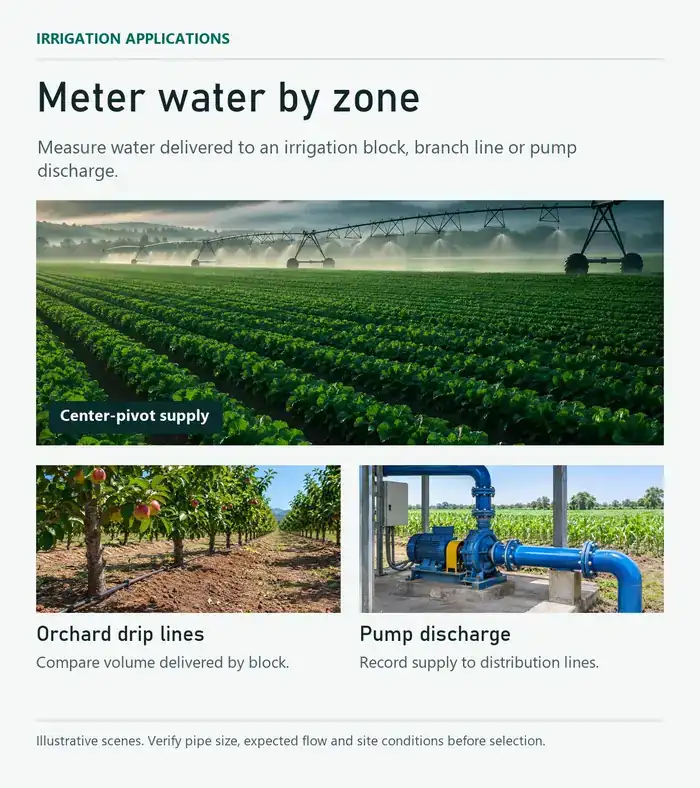
Automated agricultural irrigation
Battery power at remote pump sets and centre-pivot hydrants; IP68 in buried chambers
Tight mechanical rooms and subterranean pits
Compact flanged body, short straight-pipe demand, readings without opening the chamber
Packaging and supply
Each unit ships in a reinforced export carton with custom foam cushioning, together with wiring schematics and technical instructions — the documents a site electrician actually needs on the day the meter arrives, not a generic certificate pack.
Packing
Reinforced export carton, custom foam cushioning per model
Documents
Wiring schematics and technical instructions in each carton
OEM scope
Tailored communication frequencies, private labelling, specific protocol requests
Supply
Steady factory output and dependable lead times for repeat B2B orders
Support
Engineering consultation on sizing, flange fit and protocol mapping before the order is placed
The residential end of the same range
The same measurement principles run down to the smallest connection. Three families cover domestic and light commercial metering:
Family
Sizes
What it adds
Ultrasonic with valve control
DN15–DN25, threaded
Motorised shut-off for prepaid credit or remote disconnection; IP68; R250 / R400 / R500 by order
Multi-jet, brass or plastic
DN15–DN25, threaded (BSP)
No power required; R160; IP68 register with 360° rotating head and copper register cup; Qmax = 2 × Qp; cold potable water up to 50 °C, 10 bar (16 bar on request)
Prepaid and remote-read
DN15–DN25
Remote data transmission, tamper-proof features, long-life battery, indoor and outdoor installation
Older catalogues quote accuracy Class C for multi-jet meters. Under the current ISO 4064 edition the equivalent statement is accuracy class 2 — which is what the nameplate and the test report carry.
Questions buyers ask
One path assumes a symmetrical velocity profile. Two paths average across the section, so a slightly disturbed profile still produces a stable number — which is what a bulk meter sees on a real main.
Measurement down to 1/400 of the permanent flow. On a district main that is the band where night leakage sits, so the leak becomes a number in the data rather than a complaint later.
LoRaWAN when you control a gateway and want the meters on your own network. NB-IoT when there is no gateway and the meter has to reach the operator network directly. Both are available on this unit, with 4G and RS485 as further options.
More than eight years of service from the internal 3.6 V lithium cell. The reporting interval is the variable — give us the interval and we quote the life against it.
Yes. IP68 on the whole assembly, including the cable gland, so a damp vault or a submerged pit is a normal installation rather than a special build.
Pipe DN and flange standard, expected flow range including the minimum, water temperature, the communication option and the platform it must talk to, plus quantity and destination market.
Send the pipe, the flow range and the protocol
You will get a quotation with the meter, the module and the flange drawing matched to that combination — not a generic datasheet with a blank where the model should be.